Key West Real Estate

Joe D. Wells, Jr. is a FL Real Estate Sales Assoc. Who offers his background in Finance and his local knowledge of Key West and the Florida Keys to help you with your buying and/or selling of real estate.

To contact Joe. Click Here
Search Key West Real Estate Listings Click Here
Map Searches Click Here

Sitemap XML RSS

Friday, December 27, 2013

Fed: By End of 2014, Stimulus Will Be Over

Fed: By End of 2014, Stimulus Will Be Over

The Federal Reserve announced on Wednesday that it would begin gradually winding down its bond-buying stimulus program next month.
The Fed has been purchasing $85 billion per month in Treasury and mortgage-backed securities. In January, it will reduce its purchases by $10 billion to $75 billion, and then curtail purchases each month afterward. By the end of next year, the Fed plans to end the monthly purchases completely.
In the last year, the Fed has purchased more than $1 trillion in Treasury and mortgage-backed securities. Fed officials have said the purchases have helped to reduce borrowing costs, and it credits the program for helping to contribute to an improving housing market.
The Fed said that it plans to hold short-term interest rates near zero, and any rises likely would not come until the the end of 2015.
Both policies are aimed at holding down borrowing costs.
Previously, the Fed had said it would keep short-term interest rates near zero until the unemployment rate fell to a certain level. But the Fed announced Wednesday that short-term interest rates would stay near zero “well past the time that the unemployment rate declines below 6.5 percent.”
Source: “Fed to Start Unwinding Its Stimulus Next Month,” The New York Times (Dec. 18, 2013)

Visit us online

Mortgage Rates Moderately Higher

Post by Joe D Wells Key West Real Estate Agent Written by Matthew Graham
Mortgage Rates Moderately Higher
Dec 26 2013, 3:24PM
Mortgage rates continued slightly higher into 3-Month Highs today.  Movement in the mortgage market depends on many factors, but one of the most important for any market is liquidity.  This is most simply thought of as the presence of buyers and sellers interested in trading at similar prices.  The more of those buyers and sellers, and the more they see eye to eye on what prices should be, the more 'liquidity.'
With that in mind, there is no liquidity during these holiday weeks.  That's been especially true of this week where Christmas fell on a Wednesday.  That made today a sort of unofficial holiday and the effect on market conditions isn't likely to change tomorrow. Things might be just slightly more busy if tomorrow was the last chance to trade in 2013, but there will be 2 days for that next week.
The point to all this is that the lack of participation indirectly hurts rates.  It's not that trading levels in bond markets are much worse today.  In fact, the mortgage-backed-securities that most directly influence rates (MBS) are slightly improved.  But when lenders can't be assured of finding willing buyers for the loans they're originating, they're forced to raise margins to account for that risk, thus pushing rates higher.
This isn't likely to change until at least next week and more certainly, the week after that.  Between now and then, there will be a certain randomness to market movements that's not often seen outside the holidays and an ongoing upward pressure on rates, albeit small in the big picture.
Rates only rose the equivalent of roughly 0.02 to 0.03% today, but most of that change would be seen in the form of higher prices for Tuesday's rate quotes.  That means the most prevalently quoted rate for ideal, conforming 30yr Fixed loans is still 4.625% (best-execution) with  4.75% as close as it's been since early September.

Loan Originator Perspectives

"Flat day today as borrowers, loan officers, and bond investors ponder their Christmas gifts and plans for 2014. Not surprising that new loan origination is at a multi-year low. Among the less than exciting news of the day, the 10 year treasury yield reached 3.0%, the highest since early September. We'll hope it recovers once Dec employment and spending data hit." -Ted Rood, Senior Originator, Wintrust Mortgage

Today's Best-Execution Rates
  • 30YR FIXED - 4.625%
  • FHA/VA - 4.25%
  • 15 YEAR FIXED -  3.5%
  • 5 YEAR ARMS -  3.0-3.50% depending on the lender

Ongoing Lock/Float Considerations

  • The prospect of the Fed reducing its asset purchases weighed heavy on interest rates for the 2nd half of 2013, causing volatility and generally pervasive upward movement.
  • Tapering ultimately happened on December 18th, 2013.  Markets had done so much to come to terms with it ahead of time that it essentially just confirmed the the 6 month move higher in rates, but didn't make for another immediate spike higher.
  • That said, we should assume that we're still in a rising rate environment on average.
  • NOTE: Lenders will be adjust rate sheets at various times in December and January to account for the most recent hike in Guarantee Fees.  This will unequivocally raise rates by at least an eighth of a percent for almost every borrower, and in most cases .25-.375%.  Depending on the lender, those changes will take place overnight and have already begun.
  • (As always, please keep in mind that our Best-Execution rate always pertains to a completely ideal scenario.  There are many reasons a quoted rate may differ from our average rates, and in those cases, assuming you're following along on a day to day basis, simply use the Best-Ex levels we quote as a baseline to track potential movement in your quoted rate).
Visit us online

Monday, December 16, 2013

The Most Overvalued Housing in the World – Key West Homes for Sale

Homes in Canada are overvalued by 60 percent, according to a new report from Deutsche Bank that looks for the most overvalued housing markets among 20 developed countries. This makes Canadian homes the most overvalued in the world, according to the study. The study compares housing prices to historical norms.
When compared to rent, home prices in Canada were found to be 88 percent overvalued. In terms of income levels, home prices compared were found to be 32 percent overvalued, according to the Deutsche Bank study.
“It’s true, housing does look very overvalued in Canada, particularly here in Toronto and in other major cities like Vancouver for example,” says David Madani of Capital Economics.
The Bank of Canada recently warned that high household debt levels—which have been rising with increasing home prices—are one of the country’s biggest economic risks. However, many real estate professionals there are not seeing reason for alarm.
“There’s no bubble,” Desmond Brown of Royal Lepage told CBC News. “We have the low interest rates, we have the immigration of 100,000 people coming into Toronto every year; there’s no bubble in Toronto.”
A newly-released RE/MAX survey projected that average home prices in Canada will rise 3 percent in 2014 to average $390,000. That would follow a 4 percent increase in home prices this year.
Some of the countries found to have the most overvalued housing, according to the study, are:
  • Canada: 60%
  • Belgium: 56%
  • New Zealand: 51%
  • Norway: 49%
  • Australia: 40%
  • France: 33%
  • U.K.: 31%
  • Sweden: 24%
  • Finland: 22%
  • Spain: 16%
Meanwhile, the U.S. was found to be undervalued by 6 percent. The most undervalued real estate is found in Japan, which is undervalued by 39 percent.
Source: “Canada Has Most Overvalued Housing Market: Deutsche Bank,” The Huffington Post Canada (Dec. 11, 2013) and “Canadian real estate most overvalued in world, study says,” CBC News (Dec. 12, 2013)

$7.85M Vegas Mansion Listed in Bitcoins – Key West Luxury Homes for Sale

An owner of a Las Vegas mansion says he’s willing to accept the online currency known as “bitcoin” in the sale of his home.
The home’s asking price of $7.85 million may be one of the most expensive homes ever marketed using the online currency.
“Bitcoin peer-to-peer trading began in 2009,” the Associated Press explains. “The value is purchased through an exchange web site with a mainstraim paper currency, such as dollars or euros, though trading isn’t government-regulated.”
Using the bitcoin currency may streamline international business deals, Julian Tosh, a consultant and owner of bitcoinsinvegas.com told the Las Vegas Review-Journal. “There are a bunch of people who have bitcoins, and they’re dying for a place to spend it.
As of Friday, a bitcoin was valued at about $870.
One of the biggest risks with bitcoins is its volatility in value. “Locking in a price for such a large transaction is going to be kind of difficult,” Tosh says. “If the value is changing 30 percent a day, how do you quantify that in a contract and expect each side to hold on for 30 to 90 days while escrow clears?”
Still, Jack Sommer, the commercial developer who owns the property, says his openness to the new currency helps in marketing the home. Sommer says he got the idea from two of his sons who have been involved in bitcoin trading. “The advantage is that we’re expanding our market and adding some notoriety,” Sommer says.
The 25,000-square-foot remodeled mansion features marble from China, Iceland, and Brazil, a full basement, staff quarters, a secret garden, and 39 air conditioning zones.
Source: “Home for Sale: Asking $7.85 Million, Bitcoin Welcome,” Las Vegas Review-Journal (Dec. 12, 2013) and “Vegas developer selling $7.85M mansion for bitcoin,” The Associated Press (Dec. 16, 2013)

Wednesday, December 11, 2013

Mortgage Applications Rebound After Big Fall - Key West Real Estate Listings

Mortgage Applications Rebound After Big Fall

Daily Real Estate News | Wednesday, December 11, 2013
Loan demand ticked up last week, rebounding after last week’s holiday slump in which mortgage applications had plunged 12.8 percent, the Mortgage Bankers Association reports.
Applications for refinancing and home purchases rose 1 percent for the week ending Dec. 6. Broken out, refinance applications increased 2.1 percent, while applications for home purchases — viewed as a leading gauge for future home sales — rose 0.9 percent during the week.
The MBA reports that the average 30-year fixed-rate mortgage increased to its highest level since late September, averaging 4.61 percent last week. The prior week 30-year rates had averaged 4.51 percent. Fifteen-year fixed-rate mortgages also increased, rising to 3.66 percent from 3.56 percent over the prior week.
Source: “U.S. MBA Mortgage Applications Index Increased 1% Last Week,” Bloomberg (Dec. 11, 2013)


View Key West Real Estate Listings

Monday, December 2, 2013

Trouble Ahead on Home Equity Loans?

Trouble Ahead on Home Equity Loans?
Daily Real Estate News | Monday, December 02, 2013
Mortgage delinquencies are on the rise for home equity lines of credit that were taken out during the housing bubble, as well as others that are reaching the 10-year mark, Equifax data shows.
In most cases, after these loans hit the 10-year mark, borrowers must start paying not only the interest but also the principal on these loans. For many, that could mean their monthly payments could more than triple. For example, a consumer with a $30,000 home equity line of credit with a 3.25 percent initial interest rate could see their monthly payments go from $81.25 to $293.16, according to Fitch Ratings analysts.
The number of home owners missing their payments is growing, Equifax reports. Amy Crews Cutts, the chief economist of Equifax, has called the pending increase in payments on home equity lines as a “wave of disaster.”
“More than $221 billion of these loans at the largest banks will hit this mark over the next four years, about 40 percent of the home equity lines of credit now outstanding,” Reuters reports. The delinquencies will mean banks stand to lose 90 cents on the dollar for every loan that goes bad.
Analysts say that home owners who are facing a big jump in their payments may be able to refinance their main mortgage and home equity lines of credit into a new, single fixed-rate loan. Or some borrowers may find that selling their home and taking advantage of rising home prices is another way to repay their loan, analysts note.
Source: “Insight: A new wave of U.S. mortgage trouble threatens,” Reuters (Nov. 26, 2013)

View Key West Homes for Sale

Short Sales Becoming Less Favorable For Lenders - Homes for Sale in Key

Key West Real Estate - Posted by Joe D Wells By Jann Swanson Mortgage Daily News
RealtyTrac reports that the nature of distressed property sales is evolving.  In its most recent report on market and distressed sales, the company noted that changing economics are increasing the reliance on more traditional third party purchases at foreclosure auctions rather than the lender/borrower negotiated sale at less than the outstanding loan balance.
RealtyTrac has adopted a new methodology for accounting for short sales with the distressed and market rate sales report released Monday.  The company now applies a calculation to take into account the true loan balance secured by a home at the time of the sale, and additionally separating out of the short sale classification properties that sell at a public foreclosure auction short of the loan balance.   It is also including a new category of distressed sale in the report: third-party foreclosure auction sales, which represent sales at the public foreclosure auction to third parties other than the foreclosing lender.
Sales in the new category of auction sales to a third party represented 2.5 percent of sales compared to 2.8 percent in September and nearly twice the 1.3 percent share a year earlier.  Significant numbers of these auction sales occurred in Orlando and Jacksonville, Florida, each at 8.6 percent and Columbia, South Carolina at 8.1 percent.
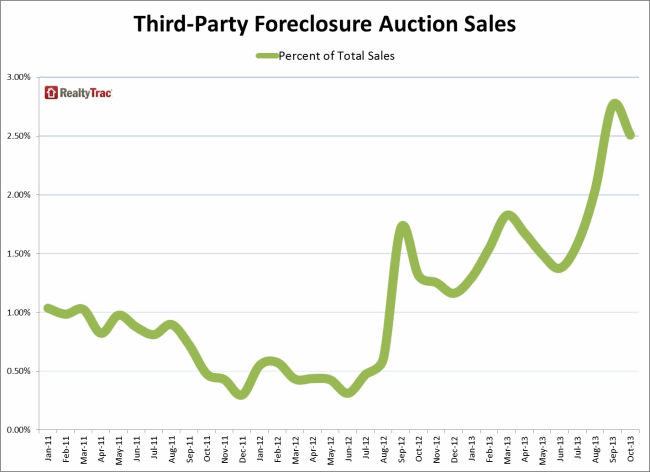


"After a surge in short sales in late 2011 and early 2012, the favored disposition method for distressed properties is shifting back toward the more traditional foreclosure auction sales and bank-owned sales," said Daren Blomquist, vice president at RealtyTrac. "The combination of rapidly rising home prices - along with strong demand from institutional investors and other cash buyers able to buy at the public foreclosure auction or an as-is REO home - means short sales are becoming less favorable for lenders."
Short sales fell from 6.3 percent of sales in September and 11.2 percent in October 2012 to a 5.3 percent share of all sales in October 2013.  States with the highest percentage of short sales in October included Nevada (14.2 percent), Florida (13.6 percent), Maryland (8.2 percent), Michigan (6.7 percent), and Illinois (6.2 percent).
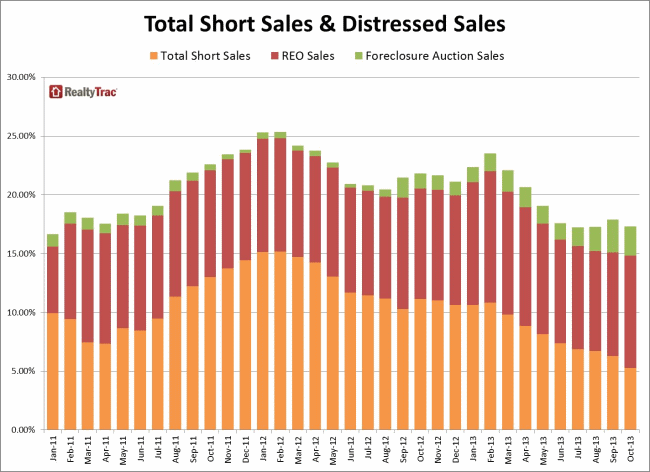


REO Sales made up 9.6 percent of the total, up from 8.9 percent in September and 9.4 percent in October 2012.  Nearly a quarter of all sales were from REO inventories in Stockton, California (24.4 percent), Las Vegas (23.8 percent), and Cleveland (22.3 percent).
Looking at total sales volume, RealtyTrac reports that residential properties including single family houses, condominiums, and townhouses sold at a slightly higher rate in October than in September.  If annualized, homes sold during the month at a rate of 5,649,965 units, an increase of 1 percent from the previous month and 13 percent above the rate in October 2012.
Sales in three of the states which had shown the strongest recovery from the housing crisis fell from a year earlier.  California sales were down 15 percent, Arizona 13 percent, and Nevada 5 percent RealtyTrac said.
Prices leveled off during the month remaining at the same $170,000 median level for both market rate and distressed properties as in September.  The gap between the two categories of properties remains a substantial 41 percent, $185,000 for a non-distressed property and $110,000 for a bank owned property or a short sale.    The median October price for all properties was 6 percent higher than one year earlier and represented the 18th consecutive month in which national prices had increased on an annual basis.
Cash sales represented 44.2 percent of all residential sales in October, down from a revised 45.0 percent in September but up from 33.9 percent in October 2012.  Cash sales were a huge part of the total in Florida (65.6 percent), Nevada (55.5 percent), Georgia (55.4 percent), South Carolina (53.9 percent), North Carolina (49.9 percent), Michigan (49.5 percent) and Ohio (49.2 percent).
Institutional investor purchases represented 6.8 percent of all sales in October, a sharp drop from a revised 12.1 percent in September and down from 9.7 percent a year ago but remained a strong factor in Memphis (25.4 percent), Atlanta (23.0 percent), Jacksonville, Fla., (22.2 percent), Charlotte (14.5 percent), and Milwaukee (12.0 percent).

View homes for sale in Key West FL Priced between $1.25M and $1.5M

Tuesday, November 26, 2013

Home Prices Rise Overall, but Some Areas Seeing Sharp Declines

Post by Joe D Wells Key West Real Estate by Jann Swanson
Home Prices Rise Overall, but Some Areas Seeing Sharp Declines

Home prices rose again nationally in September Lender Processing Services (LPS) said today, but in many areas, notably a lot of the older mill towns in the Northeast, prices are still declining, in some cases sharply.  LPS’s Home Price Index (HPI) was up 0.2 percent from August to $232,000 and has risen 8.2 percent since the beginning of the year and 9.0 percent since September 2012.
Nationally the HPI has climbed back to within 14.1 percent of the peak level reached in June of 2006 when the index was at $270,000.  In many states however, such as Florida (-35.1 percent) and even, despite its recent unprecedented gains, California (-25.3 percent) prices have far from fully recovered.
LPS derives its data from residential real estate transactions and its own property and loan-level data bases.  The HPI is the result of a repeat sales analysis representing the price of non-distressed properties by taking into account price discounts for bank-owned real estate and short sales.
Five states had increases in their HPI of half a percent or more from August to September, Nevada was up 0.8 percent, Georgia and South Carolina increased by 0.7 percent and both Florida and Illinois were up 0.5 percent.  The largest month-over-month declines were in Connecticut (-0.9 percent), New Hampshire (-0.6 percent), Massachusetts (-0.5 percent) and Colorado and Pennsylvania each of which declined 0.4 percent.
Colorado along with Texas established new peak prices in July but while Texas has gone on to even higher HPI levels and established another peak in September, Colorado has declined every month since.  The state is now down 0.7 percent from its recent peak.
The biggest price gains among metropolitan areas were almost all in the south.  Myrtle Beach, South Carolina gained 1 percentage point in September followed by Charleston South Carolina, Atlanta, and Miami with 9 percent increases.  There were five metro areas that were up 0.8 percent, Naples, Florida, Reno and Las Vegas, Ocean Pines, Maryland; and Key West. Austin, Texas gained 0.6 percent and established a new peak price at $241,000.
The big losers were mostly in New England.  Torrington (-1.0 percent), Bridgeport (-0.9 percent), and Norwich (-0.9 percent), Connecticut were followed by Springfield, Massachusetts and New Haven, down 0.8 percent.  York, Pennsylvania and Kennewick, Washington, down 0.7 percent.   Worcester, Massachusetts and Manchester, New Hampshire each lost 0.6 percent in value from September.  Denver, which had, along with Colorado, set a new peak in July is now off that peak by 0.8 percent after falling half a point in September.

Thursday, November 7, 2013

HOW TO APPEAL YOUR PROPERTY TAX


HOW TO APPEAL YOUR PROPERTY TAX

Written by Simon Campbell Posted by Joe D Wells
As surprising as may seem (if you’re not a cynic), property taxes do not always get adjusted according to market values. In fact, the National Taxpayers Union estimates that as many as 60% of properties are assessed at a higher rate than their actual market value. Furthermore, since many local governments are hurting for cash, property taxes are likely to be increased as municipalities seek ways to bridge budget gaps.
It is possible to appeal or otherwise protest property taxes; people typically undertake the process when they feel their taxes have been assessed at too high a rate. Most appeals are not successful – estimates state that only between 20% and 40% of appeals are accepted. However, well-researched cases increase one’s chances of succeeding.
The first step to appealing a property tax assessment is to double check your assessment letter . Such letters are usually mailed to homeowners on a yearly basis, but depending on where you live, it may only be every two or three years. This assessment is conducted by the local government – not a private appraiser – and the value given in the appraisal is not necessarily the current market value. The letter will also include general information about the property like the lot size, number of bedrooms, date of construction, and some sort of legal description. If you are ever interested in finding out what is on record about your home, you can contact your local government.
One of the most important details in appealing a property tax appraisal is getting in under the deadline. A challenge to the appraisal should be filed immediately because the deadline is counted based on the date the letter was sent out. Most municipalities give home owners less than 30 days to file an appeal. However, the length of this period can vary from state to state, and even within a state, so be sure to check with your local government to find out exactly how long you have to file.
After filing your initial challenge, you need to begin building your case. Start by considering any discrepancies in you appraisal. The size of the lot might be wrong, or it might be the number of bathrooms. It might even be something apparently inconsequential like the number of fireplaces the home has. If there are any factual problems, start with those.
Next, you need to do some research to figure out the actual value of your home. There are several ways to go about this, but choosing more than one method will offer a fuller picture and a stronger case. First, you can work with a REALTOR® to find properties that are very similar to yours. Finding three or more comparable properties – “comps” as real estate agents call them – can help you determine what the real market value of your home is. Second, you can use sites like Zillow.com to get a sense of what similar homes in your area are selling for. Finally, you can also hire a private appraiser. While this does cost money (usually between $350 and $600), the word of an expert does carry a lot of weight in court.
The last step is to actually present your case. To do so, contact your count assessor’s office. You can often speak to the assessor informally on the phone, but if that doesn’t work out or you are unsatisfied the results, you may request a formal review. If you go this route, you must be meticulous about meeting deadlines and following procedure, as even minor issues can be cause for the denial of your appeal. You will receive a decision in writing and this process generally takes between one and three months.
Finally, if the review does not go well, you can choose to appeal to an independent board. This does not require the help of a lawyer and the filing fee is usually quite small, around $10 to $25. However, this process can become extremely time-consuming. If you reach this stage, you are more likely to see a reduction in your assessment.

Monday, November 4, 2013

Big Tested Against Rising Rates, Housing Crash

Posted by Joe D Wells Key West Real Estate Agent BY JANN SWANSON Mortgage Daily News
Big  Tested Against Rising Rates, Housing Crash
Large financial institutions facing their annual round of stress tests were given their scripts by regulators on Friday. The tests are designed to identify ways these complex institutions might react to severe stress in the national and world economies. The Office of Comptroller of the Currency, Federal Reserve Bank and the Federal Deposit Insurance Corporation are looking for indications of forward looking capital planning processes and whether the institutions have sufficient capital to continue operations during critical periods. The information will be used by the agencies for bank supervision.
The scenarios involve a set of baseline, adverse, and severely adverse scenarios against which the institutions must test their level of preparedness. Large financial institutions with consolidated assets in excess of $10 billion are required, under a mandate of the Dodd Frank Wall Street Reform and Consumer Financial Protection Act to participate. This year 30 banks will take the tests, an increase of 12 from last year.
Each of the three scenarios include 28 variables including economic activity, unemployment, exchange rates, prices, incomes, and interest rates. The Fed says the adverse and severely adverse scenarios are not forecasts but rather hypothetical situations designed to assess the strength and resilience of the participants which are divided into $10 billion to $50 billion and over $50 billion classifications. Scenarios will be the same for both groups.
Each of this year’s scenarios examine how the biggest banks might react to jump in long-term interest rates and another housing crash over which are layered other factors such as high unemployment, or a slowdown in Asian economies. The intensity of the various factors are manipulated in accordance with the severity of the scenario.
For example, under the baseline scenario the country shows moderate economic expansion; real GDP growth accelerates while unemployment edges down and interest rates remain flat in 2014. Then short term Treasury rates increase steadily, reaching nearly 2.5 percent by the end of 2016. Home equity and property prices would appreciate modestly through 2016 while economic activity, inflation, and exchange rates outside the U.S. expand but with divergent growth patterns.
The severely adverse scenario is characterized by a substantial weakening in economic activity across all of the economies included in the scenario, a significant reversal of recent improvements to the U.S. housing market and the euro area outlook. There will be a sharp slowdown in developing Asian economies as a proxy for severe weakening everywhere. The larger decline in U.S. house prices in this scenario is viewed as particularly relevant for localities that have experienced brisk gains in house prices over the past year.
Along with the scenarios the regulators released the final “Policy Statement on the Principles for Development and Distribution of Annual Stress Test Scenarios.” The guidance outlines the consultative processes regulators will use to gather information on the institutions’ material vulnerabilities and to coordinate with each other to develop the scenarios each year. Under rules finalized last year OCC must provide the required scenarios by November 15 of each year.

Friday, November 1, 2013

Mortgage Rates Finally Make a Move


Mortgage Rates 

Mortgage Rates Finally Make a Move


After 5 straight days of almost no change on average, mortgage rates finally made a move today. Unfortunately, it wasn’t in the direction that most would hope. On a positive note, the deterioration was only seen in the “cost” side of the equation, meaning that you’d likely be quoted the same rate as yesterday afternoon, but with slightly higher closing costs (or lower lender credit, depending on your scenario). As such the most prevalent Conforming 30yr fixed rate (best-execution) remains at 4.125%.
Today’s weakness was almost exclusively a factor of one surprisingly strong piece of economic data. We often talk about the interplay between economic data and rates, focusing mainly on the important employment reports. That’s because the Employment Situation Report is by far and away the most reliable market mover for interest rates when it comes to economic reports.
Other reports can have an impact, but it’s usually smaller and happens less consistently. When it comes to the non-employment-related reports shaking up mortgage rates, it takes a big deviation from the market’s forecast.
In other words: data surveys are a fixture in financial markets. For any major report there will always be 30-80 prominent economists officially registering their predictions for upcoming data. When the data is released, if it’s much stronger or weaker than the forecast, markets react accordingly.
In today’s case, it was the Institute for Supply Management of Chicago with their monthly Purchasing Manager’s Index (or “Chicago PMI” for short) that shook things up. This is a survey of business conditions in the Chicago area, which has proven to be similar enough in composition and economic trends to the entire nation that it has become a well-regarded report.
The problem for mortgage rates is that this well-regarded report moved a whole lot more than it normally does. In fact, this was the biggest jump in over 30 years. Until that point in the day, rates looked poised to drop a bit, but the stronger economic data caused bond markets to weaken, meaning prices fell and rates rose.
Loan Originator Perspectives
“Bit of a selloff today as Chicago PMI data was surprisingly strong. While still within recent ranges, borrower pricing is slightly worse for same rates as last few days. All eyes turning to next weeks October NFP report. Whether markets will discount its validity given the DC Drama remains to be seen.” -Ted Rood, Senior Originator, Wintrust Mortgage
“What started as a very promising morning was quickly destroyed by a much better than expected Chicago PMI. Despite the surprising reports and the reprices to follow, rates are about the same as yesterday afternoon. As the day has progressed, we have regained much of the earlier losses, so I like floating overnight as lenders will be slow to pass along the improvements.” -Victor Burek, Open Mortgage
Today’s Best-Execution Rates
30YR FIXED – 4.125%
FHA/VA – 3.75-4.0%
15 YEAR FIXED – 3.25-3.375%
5 YEAR ARMS – 3.0-3.50% depending on the lender
Ongoing Lock/Float Considerations
Uncertainty over the Fed’s bond-buying plans and more recently over Fiscal Policy has been making for a tough interest rate environment.
A lack of data due to the government shutdown caused rates to experience moments of paralysis while headlines suggesting the shutdown might/might-not end, as well as a seizing-up of short term funding markets caused unexpectedly high volatility–enough to be felt in longer term rates like mortgages.
After a deal was reached to avoid going over the debt ceiling, funding markets thawed and rates returned to the same ‘wait and see’ range that existed before the Fiscal drama.
Markets continue to be most interested in economic data and its suggestions about the longer term trajectory of the economy. This will shape expectations for Fed policy in the coming months, and thus inform the direction of interest rates.
The stronger the data the more likely the Fed is seen as reducing asset purchases. Rates would rise under this scenario, but the most recent FOMC Meeting (and more importantly, the Fed’s decision to hold off on tapering) suggests that they’ll attempt to keep the pace of rising rates moderate as long as inflation isn’t adversely affected. The delayed release of the September jobs numbers on October 22nd helps confirm that.

 Make a Move

Posted by: Joe D Wells Key West Real Estate BY MATTHEW GRAHAM
Mortgage Rates Finally Make a Move
After 5 straight days of almost no change on average, mortgage rates finally made a move today. Unfortunately, it wasn’t in the direction that most would hope. On a positive note, the deterioration was only seen in the “cost” side of the equation, meaning that you’d likely be quoted the same rate as yesterday afternoon, but with slightly higher closing costs (or lower lender credit, depending on your scenario). As such the most prevalent Conforming 30yr fixed rate (best-execution) remains at 4.125%.
Today’s weakness was almost exclusively a factor of one surprisingly strong piece of economic data. We often talk about the interplay between economic data and rates, focusing mainly on the important employment reports. That’s because the Employment Situation Report is by far and away the most reliable market mover for interest rates when it comes to economic reports.
Other reports can have an impact, but it’s usually smaller and happens less consistently. When it comes to the non-employment-related reports shaking up mortgage rates, it takes a big deviation from the market’s forecast.
In other words: data surveys are a fixture in financial markets. For any major report there will always be 30-80 prominent economists officially registering their predictions for upcoming data. When the data is released, if it’s much stronger or weaker than the forecast, markets react accordingly.
In today’s case, it was the Institute for Supply Management of Chicago with their monthly Purchasing Manager’s Index (or “Chicago PMI” for short) that shook things up. This is a survey of business conditions in the Chicago area, which has proven to be similar enough in composition and economic trends to the entire nation that it has become a well-regarded report.
The problem for mortgage rates is that this well-regarded report moved a whole lot more than it normally does. In fact, this was the biggest jump in over 30 years. Until that point in the day, rates looked poised to drop a bit, but the stronger economic data caused bond markets to weaken, meaning prices fell and rates rose.
Loan Originator Perspectives
“Bit of a selloff today as Chicago PMI data was surprisingly strong. While still within recent ranges, borrower pricing is slightly worse for same rates as last few days. All eyes turning to next weeks October NFP report. Whether markets will discount its validity given the DC Drama remains to be seen.” -Ted Rood, Senior Originator, Wintrust Mortgage
“What started as a very promising morning was quickly destroyed by a much better than expected Chicago PMI. Despite the surprising reports and the reprices to follow, rates are about the same as yesterday afternoon. As the day has progressed, we have regained much of the earlier losses, so I like floating overnight as lenders will be slow to pass along the improvements.” -Victor Burek, Open Mortgage
Today’s Best-Execution Rates
30YR FIXED – 4.125%
FHA/VA – 3.75-4.0%
15 YEAR FIXED – 3.25-3.375%
5 YEAR ARMS – 3.0-3.50% depending on the lender
Ongoing Lock/Float Considerations
Uncertainty over the Fed’s bond-buying plans and more recently over Fiscal Policy has been making for a tough interest rate environment.
A lack of data due to the government shutdown caused rates to experience moments of paralysis while headlines suggesting the shutdown might/might-not end, as well as a seizing-up of short term funding markets caused unexpectedly high volatility–enough to be felt in longer term rates like mortgages.
After a deal was reached to avoid going over the debt ceiling, funding markets thawed and rates returned to the same ‘wait and see’ range that existed before the Fiscal drama.
Markets continue to be most interested in economic data and its suggestions about the longer term trajectory of the economy. This will shape expectations for Fed policy in the coming months, and thus inform the direction of interest rates.
The stronger the data the more likely the Fed is seen as reducing asset purchases. Rates would rise under this scenario, but the most recent FOMC Meeting (and more importantly, the Fed’s decision to hold off on tapering) suggests that they’ll attempt to keep the pace of rising rates moderate as long as inflation isn’t adversely affected. The delayed release of the September jobs numbers on October 22nd helps confirm that.

Wednesday, October 30, 2013

Where Are Mortgage Rates Heading in 2014

Where Are Mortgage Rates Heading in 2014?

Daily Real Estate News | Wednesday, October 30, 2013
Mortgage rates will likely rise above 5 percent in 2014 and average 5.3 percent by the end of 2015, according to the Mortgage Bankers Association’s forecast.
That would mark a big jump over where mortgage rates stand now. The MBA reported this week that the 30-year fixed-rate mortgage averaged 4.33 percent, the lowest average since June.
The MBA expects that the Federal Reserve will decide to taper its $85-billion per month bond-purchasing program in early 2014 and end it altogether in September 2014. The Fed’s bond buying program has been keeping mortgage rates low. The Fed has hinted in recent months that it will soon be winding down the program.
“As a result, mortgage refinancing will continue to drop, and borrowers seeking to tap the equity in their homes will be more likely to rely on home equity seconds rather than cash-out refinances,” says Jay Brinkmann, the MBA’s chief economist.
The MBA said in its forecast that it expects home purchase applications for mortgages to rise 9 percent next year, following expected continued home sales and price increases.
However, the MBA projects that overall mortgage originations will drop 32 percent in 2014, as the number of refinancing applications post a large drop in the new year due to expected rising interest rates.
While refinancings make up the bulk of home applications today, that trend is expected to reverse next year. Purchase loans are expected to make up 60 percent of originations next year compared to about 38 percent this year.
“We are projecting home purchase originations will increase in 2014 due largely to gains in home sales and home prices,” says Brinkmann. “We expect to see a decline in the share of sales paid for with cash, and higher average LTVs on purchase mortgages, due to the rise in home prices.”
Source: “U.S. Mortgage Applications Increase as Rates Edge Down,” Reuters (Oct. 30 2013) and “Purchase Loans Expected to Buck Rising Mortgage Rates Next Year,” Inman News (Oct. 29, 2013)

Visit us Online
 

Monday, October 28, 2013

2.5M Mortgages Emerge From Negative Equity

2.5M Mortgages Emerge From Negative Equity
DAILY REAL ESTATE NEWS | MONDAY, OCTOBER 28, 2013
More home owners are edging above water with their mortgages: 2.5 million U.S. properties emerged from underwater or negative equity in the second quarter, according to CoreLogic. The total number of residential properties with a mortgage with equity stands at 41.5 million.
However, some home owners are still waiting for equity to return: 14.5 percent of all residential properties with a mortgage—or 7.1 million homes—are still considered underwater, with owners owing more on their mortgage than their home is currently worth. But that number has been falling as home prices rise across the nation. At the end of the first quarter, that number had stood at 9.6 million.
“Seeing fewer underwater mortgages is no mystery, given the continued rise in home values over the last 12 months,” says Mark Twerdok, head of KPMG’s credit risk practice. “Investor buying has been the initial driver of the appreciation in areas with the most underwater homes. Now, investor buying has widened to include the owner-occupied market [buyers who intend to live in the homes they purchase]. This is good news since these more traditional buyers will ensure the appreciation trend will continue over the near future. In addition, as long as new construction does not change the supply/demand balance in favor of excess supply, appreciation should persist until most of the underwater loans are gone.”
Thirty-five percent of all negative equity mortgages are concentrated in five states alone:
Florida
Nevada
Arizona
Michigan
Georgia
Source: “Up For Air: Big Decline In Underwater Mortgages,” realtor.com (Oct. 24, 2013)
Visit us online

Thursday, October 17, 2013

Home Prices Reach 2009 Levels, Gains Moderating Key West Real Estate Blog

Posted by Joe D Wells – Key West Real Estate
BY JANN SWANSON
Home Prices Reach 2009 Levels, Gains Moderating
With the FNC Residential Price IndexTM (RPI) levels for August home prices have climbed back to December 2009 levels. But the index, while it rose 0.6 percent from the July level, is beginning to display signs of a subsiding momentum.
August represented the 18th consecutive month in which home prices have climbed on the RPI, indicating that the housing recovery remains well underway. However that month-over-month increase was smaller than the 0.8 percent monthly increase in July and 0.9 percent in June. The year-over -year appreciation increased over that of earlier months, gaining 5.3 percent compared to the 4.7 percent and 4.6 percent annual increases in June and July. The FNC 100-MSA composite is based on sales of non-distressed new and existing residential properties in the 100 largest metropolitan areas.
The September median sales-to-list price ratio was also moderated, coming in at 96.2, a 3.8 percent listing price markdown among closed sales, compared to 97.2 in August.
Housing market fundamentals, especially foreclosure filings and the foreclosure inventory, continued to improve and contributed to rising home prices. The share of the home sales coming from foreclosures dipped in August to 12.4 percent from 12.7 percent in July and was more than 4.5 percent below one year earlier.
Nearly all of the major housing markets in the FNC 30-MSA posted price increases in August, but some also showed signs of weakening. Phoenix and Los Angeles had month-over-month declines of 0.1 and 0.4 percent respectively following many months of increases averaging 2.0 percent. Denver, another strong-performer in the current recovery, also suffered a small loss in August.
San Antonio recorded the largest monthly increase, 2.1 percent and Las Vegas climbed 1.8 percent, the 10th consecutive month of rapid price acceleration. Home prices in Charlotte and New York also performed strongly. Chicago, where foreclosures sales made up 21.8 percent of the market in August, prices have appreciated by the smallest amount of any city in the 30 MSA index.
FNC’s RPI blends public records of residential sales prices with real-time appraisals of property and neighborhood attributes. The RPI excludes sales of foreclosed homes, which are frequently sold with large price discounts, reflecting poor property conditions.

Wednesday, October 16, 2013

Mortgage Rates React to Debt Deal - Key West Real Estate

Post by Joe D Wells Key West Real Estate Homes for Sale
Mortgage Rates React to Debt Deal
Mortgage rates fell today, recovering yesterday's losses on average.  Some lenders' rate sheets were just slightly better or worse than yesterday's latest, but nearly every lender had been worse this morning before releasing revised rate sheets in the afternoon.  30yr fixed best-execution remains at 4.375%, though 4.25% continues to make sense for some scenarios, depending on the difference in cost from 4.375% and personal preference.
The promise of an end to the government shutdown took center stage today, helping both stocks and bonds improve vs yesterday.  The full effects of a finalized deal won't be known until tomorrow, assuming the House and Senate pass the legislation tonight, as expected.
From a market-watching standpoint it's important to keep in mind that the reason we're seeing an unexpectedly positive reaction to the debt deal in the world of longer term interest rates has much to do with the fact that we had been seeing an unexpectedly negative reaction to the overall fiscal drama as October progressed.  Past examples of similar drama suggest that it's usually over-credited as a motivation for longer term rates (like mortgages) when other factors remain more important.
That's not to say that the drama seen so far and the headlines today aren't capable of causing volatility for interest rates, simply that the volatility is likely to be a "wash" when all is said and done.  At that point, the expected source of inspiration remains, as ever, the big jobs report that had been scheduled for October 4th.
Loan Originator Perspectives


"Great day to be floating. Certainly the question of lock/float is important as usual as most consumers are hoping the rally continues. The inconsistencies within the rallies and sell-offs of late, lack of data, and government incompetence leave us at an unpredictable scenario on lock vs. float. We are still within the current range, with a strong rally today one should strongly consider locking. Floating is always risky, however there may be more room for improvement here. Float with extreme caution." -Constantine Floropoulos, Quontic Bank
"Here's to hoping the debt limit deal happens and puts an end to our slow leak higher in recent days. Maybe we can now focus on the lack of tapering and economic numbers that should confirm a slowing economy. This will be good for rates. Will also be interesting to see if the NFP report is released any time soon." -Mike Owens, Partner, Horizon Financial Inc
"Rates improved after today's debt deal announcement.  Floating borrowers might want to wait until tomorrow unless their lenders have substantial price improvements this PM. Rates aside, it's great to (hopefully) have a short term solution to help those impacted by the shutdown." -Ted Rood, Senior Originator, Wintrust Mortgage
"Congress acts and MBS get giddy (good news for rates), but it may be short lived. As my dad used to say, Tomorrow never comes and yesterday don't matter. If you like your rate quote, take it today." -Bob Van Gilder, Finance One Mortgage
"It seems all markets are pleased with the ability of our government to kick the can just a little further down the road. Rate sheets to start the day were worse than the prior day, but by days end lenders repriced better bringing rates closer to their best levels in several months. In my opinion, the gains with MBS justify better pricing, so I think floating overnight might reward you in the morning. But as always, nothing wrong with locking now especially if you are within a couple weeks of closing." -Victor Burek, Open Mortgage

Today's Best-Execution Rates
  • 30YR FIXED - 4.25% -4.375%
  • FHA/VA - 4.0-4.25%
  • 15 YEAR FIXED -  3.375-3.5%
  • 5 YEAR ARMS -  3.0-3.50% depending on the lender
Ongoing Lock/Float Considerations
  • Uncertainty over the Fed's bond-buying plans and more recently over Fiscal Policy has been making for a tough interest rate environment.
  • A lack of data due to the government shutdown caused rates to experience moments of paralysis while headlines suggesting the shutdown might end have caused pockets of volatility.
  • Expectations for "tapering" (a reduction in "QE3" asset purchases) mounted over the summer and September 18th was seen as the most likely day for a potential tapering announcement
  • But the Fed decided to keep a change in QE amounts on hold until the economy could more convincingly show that rising rates (which had been rising because markets expected the Fed to taper!) wouldn't be too big an impediment to further improvement.
  • The Fiscal drag is also a consideration for the Fed and we believe this to be one of the factors preventing rates from rising more quickly
  • Rates moved lower after the Fed held off on tapering, but the window of opportunity may be closing.  Ultimately, that will depend on the economic data that's on hold due to the shutdown
  • (As always, please keep in mind that our Best-Execution rate always pertains to a completely ideal scenario.  There are many reasons a quoted rate may differ from our average rates, and in those cases, assuming you're following along on a day to day basis, simply use the Best-Ex levels we quote as a baseline to track potential movement in your quoted rate).
  • Visit Joe Online

Tuesday, October 15, 2013

Mortgage Rates Rise to 3-Week Highs – Key West Real Estate Blogs


Key West Real Estate for Sale
Mortgage Rates Rise to 3-Week Highs
Mortgage rates rose moderately today, bringing them to their highest levels since September 23rd.  Though the recent move higher has happened very gradually, it’s also been fairly determined with none of the past five sessions seeing a move lower.  Today’s incremental dose of weakness was notable in that it was finally enough to unequivocally nudge 30yr fixedbest-execution back up to 4.375%, though buying down to 4.25% continues to make sense for some scenarios depending on personal preference.
Last week, we’d increasingly noted that rates had no incentive to move any lower without market participants getting their hands on the important Employment Situation Report–the most important piece of economic data each month and recently postponed due to the shutdown.  Despite the lack of motivation to move lower, rates held their ground fairly well–remaining in a new range that was distinctly separate from that which characterizes most of the July-September time frame.
At current levels, we’re beginning to blur the lines between these two zones of recent rate levels.  The outlook will remain blurry until the shutdown ends and the important economic data is flowing again.  It continues to be the case that we can’t expect a meaningful move lower without a downbeat jobs report.
Loan Originator Perspectives
“Continued leakage in MBS market as rates trudged upward again today. No incentive for them to improve, given the lack of economic data and DC Dysfunction. We’re hoping to stay in current ranges, but if rates have suffered with just the perception of any progress in DC, might be wise to expect more of the same if/when actual progress occurs. My consensus: if you like your rate, lock while the getting is good. ” -Ted Rood, Senior Originator, Wintrust Mortgage
“The range is still in-tact, however it has moved to a higher threshold. As long as we stay within the range the outlook is semi-bullish. We have an overwhelmingly high risk factor in the status of our government reaching a deal, which can unfold negatively for us either way. If we reach a deal everything is fixed and the risk on trade continues, if we don’t reach a deal the US bond market will suffer tremendously. I would cautiously float here, strongly recommend locking, too many unknowns, delayed data points, etc.” -Constantine Florpoulos, Quontic Bank
 Today’s Best-Execution Rates
  • 30YR FIXED - 4.25% -4.375%
  • FHA/VA – 4.0-4.25%
  • 15 YEAR FIXED -  3.375-3.5%
  • 5 YEAR ARMS -  3.0-3.50% depending on the lender
Ongoing Lock/Float Considerations
  • Uncertainty over the Fed’s bond-buying plans and more recently over Fiscal Policy has been making for a tough interest rate environment.
  • A lack of data due to the government shutdown caused rates to experience moments of paralysis while headlines suggesting the shutdown might end have caused pockets of volatility.
  • Expectations for “tapering” (a reduction in “QE3″ asset purchases) mounted over the summer and September 18th was seen as the most likely day for a potential tapering announcement
  • But the Fed decided to keep a change in QE amounts on hold until the economy could more convincingly show that rising rates (which had been rising because markets expected the Fed to taper!) wouldn’t be too big an impediment to further improvement.
  • The Fiscal drag is also a consideration for the Fed and we believe this to be one of the factors preventing rates from rising more quickly
  • Rates moved lower after the Fed held off on tapering, but the window of opportunity may be closing.  Ultimately, that will depend on the economic data that’s on hold due to the shutdown
  • (As always, please keep in mind that our Best-Execution rate always pertains to a completely ideal scenario.  There are many reasons a quoted rate may differ from our average rates, and in those cases, assuming you’re following along on a day to day basis, simply use the Best-Ex levels we quote as a baseline to track potential movement in your quoted rate).

Florida Keys Real Estate Search

Search This Blog