Key West Real Estate

Joe D. Wells, Jr. is a FL Real Estate Sales Assoc. Who offers his background in Finance and his local knowledge of Key West and the Florida Keys to help you with your buying and/or selling of real estate.

To contact Joe. Click Here
Search Key West Real Estate Listings Click Here
Map Searches Click Here

Sitemap XML RSS

Saturday, July 27, 2013

Volatility Ahead for Mortgage Rates - OceanBlueRealEstate.com

Volatility Ahead for Mortgage Rates

Market Summary from Mortgage Daily News
Mortgage rates were mixed this week after moving with a more decidedly positive slant last week.  Monday was the best day of the week by a small margin and rates spent the next two days moving higher.  The last two days of the week helped erase most of that weakness with rate sheets very similar to last week's latest.
30yr Fixed best-execution remains at 4.5% though paying points to move down to 4.25% may be an attractive option for borrowers planning on being in the loan for more than 5 years.  Next week's events stand a good chance to break this week's relative monotony.
"The day to day movement in rates was the smallest we've seen in months and this is characteristic of the sort of consolidation that was likely to follow the spike to  multi-year highs on July 5th.  So now what?   Next week's events will likely  "break" the consolidation seen over the past several weeks.  When that happens, it may happen big.  We could revisit July 5th highs around 4.875 or come as close as we've been to 4% since mid June.  Of course, there's always the chance of something in between.  The point is that the potential for big movement is there, and the warning is that this is STILL a long-term rising rate environment until proven otherwise."
-Matthew Graham, Chief Operating Officer, Mortgage News Daily
30 Year Fixed Rate Mortgage
Week in Review
Rates shown below are based on the 30 Year Fixed Rate Mortgage
Beginning Average:4.41%
Ending Average:4.44%
Weekly Change:+0.03%
Yearly Change:+0.84%
Friday, July 19, 2013  :   4.41% (-0.03%)
Mortgage rates were slightly lower this morning, but many lenders offered improved rate sheets as the day progressed, bringing average just barely below the lows of the week.  The lows were achieved only in terms of closing cost for most lenders.  In other words, the most prevalent 30yr fixed quote for top-tier borrowers (best-execution) remains at 4.5 percent on average, and simply costs slightly less in terms of closing costs (or returns slightly more if you're not paying any). Lenders continue to be stratified, meaning that pricing varies more than average between lenders and even in cases where two lenders may be in similar territory on one rate, the costs to move between rates can be quite different.  For instance, using a $200k loan as an example, one lender might only charge $1100 to move from 4.5% to 4.375% whereas another might be just over $1600.  Buying down to 4.375 or 4.25% can good sense in some cases.
Monday, July 22, 2013  :   4.36% (-0.05%)
Mortgage rates were lower again to begin the week as weaker-than-expected economic data helped rates improve slightly in the morning.  The overall level of activity in bond markets that underpin mortgage and Treasury rates remained subdued, but the trading levels were strong enough for a few lenders to offer a mid-day rate-sheet improvement on top of the already stronger rate sheets this morning.  The result is an average top-tier rate (best-execution) that's now closer to 4.375% compared to last week's 4.5%.  But the reason for that is more complicated than it seems at face value.
Tuesday, July 23, 2013  :   4.41% (+0.05%)
Mortgage rates bounced slightly higher today, bringing them almost perfectly back in line with Friday's levels.  Trading conditions in the underlying 'mortgage-backed-securities' and US Treasuries markets were underwhelming at best.  Just as there hasn't been much by way of conviction as rates have been falling, today's bounce higher was similarly incidental.  The day to day movements in rate continue to be much smaller than recent averages (or perhaps it's better to say they've been more "normal" whereas recent averages have been extreme from May through early July).  Whatever the case, prevailing rate quotes remain in the same situation as yesterday where the average may be 4.375, but the adjacent rates of 4.5 and 4.25 will make more sense in terms of best-execution.
Wednesday, July 24, 2013  :   4.49% (+0.08%)
Mortgage rates were higher again today, but this time at the quickest pace in nearly two weeks.  It was a clear departure from the recent trend of small day to day changes and a wake up call in some regards as to the lingering presence of volatility.  In today's case, the weakness was brought on in part by stronger economic data at home and abroad, though more esoteric factors are equally in play.  The net effect is an average best-execution rate that moves back to 4.5% whereas attractive buydowns to 4.25% had been dragging that average lower in recent days (those still may be attractive in some cases, but they're almost universally more expensive than yesterday, both in terms of higher outright cost, comparative advantages versus other rates.  In other words, it take more time to break even on buying your rate down today in addition to the overall move higher for all rates).
Thursday, July 25, 2013  :   4.48% (-0.01%)
Mortgage rates began the day moderately higher, but as market conditions improved most lenders released improved rate sheets bringing offerings more in line (or slightly better than) yesterday's.  This keeps the 30yr fixed best-execution rate at 4.5%, though buying down to lower rates can make sense in some cases.  For the first this week, lender pricing strategies are highly stratified.  This simply means that some are in noticeably better territory, some are almost imperceptibly stronger, and a few others either have yet to reprice or haven't quite caught up with the rest of the pack yet.
Friday, July 26, 2013  :   4.44% (-0.04%)
Mortgage rates improved today, capitalizing on friendly market movements that arrived too late in yesterday's session to make it onto rate sheets in any meaningful way.  While lenders may release 1-3 rate sheets each day, MBS ('mortgage-backed-securities') are constantly trading in the secondary market.  It's operationally inefficient for lenders to release new rate sheets every time the underlying markets move, so there are periodic thresholds where "enough is enough" to change lockable rate offerings.   While part of yesterday afternoon's positivity was sufficient for that to happen, lenders passed along more of it this morning after bond markets carried the gains through the overnight session.

Wednesday, July 24, 2013

Key West Real Estate Listings OceanBlueRealEstate.com

Current Key West Real Estate listings updated daily from the Key West MLS. Use our search to find real estate in Key West, FL for sale or view real estate listings in Key West below our search box.


Here are updated Key West MLS real estate listings for sale showing Homes for sale in Old Town Key West Florida


Tuesday, July 23, 2013

Home Price Recovery Lags in Judicial Foreclosure States

BY JANN SWANSON mortgage news daily

The Federal Reserve Bank of New York has updated and released proceedings of a conference it held last October in conjunction with the Rockefeller Institute of New York. The conference, entitled Distressed Residential Real Estate: Dimensions, Impacts, and Remedies was devoted to three main topics:
  • An assessment volumes of properties that remained in foreclosure and in the real estate owned (REO) pipeline on a state, local, and national basis.
  • Research on the impact of foreclosures and distressed sales on home prices, ownership rates, communities and families, and state and local government finances.
  • Policy initiatives intended to reduce the number of foreclosures and their associated impacts.
At the conference national and state level data as of June 2012 was provided by CoreLogic. Categories included the number of properties which were 90-plus days delinquent, in foreclosure, and in REO, as well as alternative projections of future REO inventories based on the number of days a loan stays in a ninety-plus day bucket and the average days in foreclosure.
That information, now updated to March 2013, shows just under 3 percent of all mortgaged one-to-four-unit residential properties were ninety or more days delinquent, essentially unchanged from June 2012. This is below the peak of about 5½ percent reached in late 2009 to early 2010, but well above the pre-crisis average of just under 1 percent.
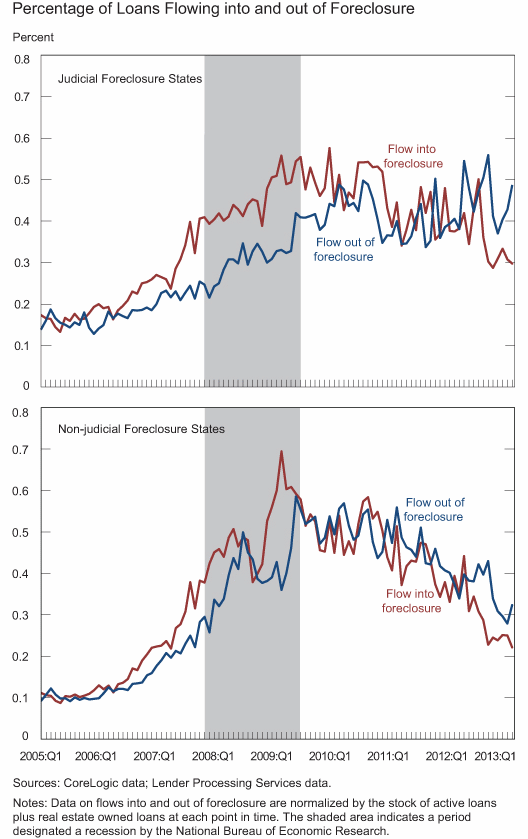
In contrast, the percentage of loans in foreclosure, which had leveled off at around 4 percent from early 2011 through mid- 2012, declined to around 3½ percent by early 2013 because, for the previous nine months more loans had moved out of foreclosure than moved in. Finally, the percentage of properties in REO continued to decline gradually over the period from mid-2012 to early 2013.
The conference looked at the large disparity in performance between states with a judicial foreclosure process and those with a non-judicial process and noted that the average number of days that a mortgage loan is ninety-plus days delinquent at the time the foreclosure process is started is roughly comparable in judicial and non-judicial states and that the percentage of loans flowing into foreclosure is also around the same. The key distinction is in the rate of flow out of foreclosure or, alternatively, the average number of days a loan/property remains in the foreclosure process.
The difference between the judicial and non-judicial states is seen more clearly in the following scatter plot. The horizontal axis measures a state's ninety-plus-day delinquency rate in the first quarter of 2010 when that rate peaked nationally. The vertical axis measures a state's foreclosure rate in the first quarter of 2013. The blue diamonds represent non-judicial and usually non-judicial states while the red squares represent the judicial and usually judicial states. The corresponding blue and red lines are least squares regression results for the respective sets of observations. For a given level of the ninety-plus-day delinquency rate in the first quarter of 2010, the judicial states have considerably higher foreclosure rates in early 2013, indicating that the length of time a loan/property remains in the foreclosure process in the judicial states is considerably longer than in the non-judicial states. New York, New Jersey, and Florida stand out as the most extreme examples of this phenomenon.
The considerably larger volume of loans in the foreclosure process in the judicial states appears to be impeding home price recovery in those states. As can be seen in the chart below, for a given peak-to-trough decline in home prices, the judicial foreclosure states have seen a meaningfully more modest improvement in home prices since the trough. (The exception is North Dakota, a small state with unusual demographics related to its current energy boom.) One potential explanation for this relationship is that potential homebuyers in the judicial states recognize that a large number of distressed sales have yet to occur, and this consideration has influenced the prices they are willing to offer for homes currently on the market.
Conference participants concluded that non-judicial states are much further along in reducing the backlog of loans in foreclosure and that have prices have recovered more in the non-judicial states
Visit Us

Fannie: Fast Rise in Mortgage Rates Could Hurt

The rise in mortgage rates over the last couple of months has been “significant” and could hamper the housing recovery, economists note in Fannie Mae’s Economic Strategic Report for July. However, home sales so far have been little affected by the spikes, they say.

The 30-year fixed-rate mortgage has risen more than 110 basis points from the first week of May to the end of June. In early July, it started to ease somewhat. Still, the report says that despite the increases, rates are still near historical lows. It’s the sudden rise in such a short time that has been alarming, the economists note.

Mortgage applications for home purchases have fallen about 9 percent since early May, when the rise in rates began. However, pending home sales during that same period rose to the highest level in more than six years. Many of those sales, though, are in cash, which means they may be less tied to the rise in mortgage rates.

Fannie Mae economists predict that mortgage rates will continue a gradual rise and average 4.7 percent in the fourth quarter. That is about 40 basis points higher than economists had predicted a month ago.

Economists predict home sales will rise about 8 percent in 2013, and the median home price will be $189,000 for existing homes and $276,000 for new homes in the fourth quarter.

Source: “Fannie Mae Expects Rates to Continue Higher,” Mortgage News Daily


Visit Us

Florida Keys Real Estate Search

Search This Blog