Key West Real Estate

Joe D. Wells, Jr. is a FL Real Estate Sales Assoc. Who offers his background in Finance and his local knowledge of Key West and the Florida Keys to help you with your buying and/or selling of real estate.

To contact Joe. Click Here
Search Key West Real Estate Listings Click Here
Map Searches Click Here

Sitemap XML RSS

Monday, March 10, 2014

West Tries to Loosen Russia's Gas Grip - West Tries to Loosen Russia's Gas Grip

Western officials are scrambling to loosen Russia's energy stranglehold on Ukraine, the latest sign of growing pressure on Moscow to end the crisis. ...read more    

Asian Demand for Milk Shakes Market

Asia's growing thirst for milk is spilling over into the U.S. market, pushing up prices for consumers and pressuring profits for some food makers. ...read more    

Key West Florida Homes for Sale in Old Town


Key West Florida Homes for Sale in Old Town

Side by side comparison of current listings of homes for sale in south Old Town Key West and north Old Town Key West.


Monday, February 10, 2014

Key West Real Estate Blogs – Builders Hike Their Prices

Contact Key West real estate agent Joe D Wells for you real estate needs in Key West and the Florida Key for finding key west homes for sale and for Key West commercial real estate services.

More builders are reporting they’re raising their prices on new homes. Twenty-four percent of 231 builders recently surveyed say they raised their prices in December, which is an increase over a 19 percent low reported in November, according to John Burns Real Estate Consulting Inc. data. The percentage of builders who say they lowered their prices fell to 8 percent in December, after a 12 percent high in October.
“The pricing environment notably improved,” Jody Kahn, a senior vice president at Burns, told The Wall Street Journal. “It’s still not back to where we were earlier in [2013] with builders raising prices aggressively.”
In early 2013, more than half of the builders surveyed had reported raising their prices, with some markets, such as California and Arizona, even posting double-digit increases from 2012 levels. But prices curtailed during a slowdown in the summer months as interest rates rose.
Lately, however, interest rates have mostly remained flat — around 4.4 percent to 4.5 percent averages — and improving employment numbers have builders feeling more confident again.
Average new-home prices reached an all-time high of $340,300 in November, according to the U.S. Census Bureau.
Michael Gapen, senior U.S. economist at Barclays, predicts that home prices will rise 7 to 8 percent this year adding to last year’s gains of 11 to 12 percent.
Buyers “know that builders tend to make price increases at the first of the year,” says Gene Swang, a division president for David Weekley Homes. “I think customers are concerned that if they didn’t get a home under contract [in December], they’d see higher prices in another month.”
Source: “Santa’s Gift to Builders: Higher Home Prices,” The Wall Street Journal

Friday, February 7, 2014

CoreLogic asks if Poor Construction Hiring is New Normal - Key West Homes for Sale in Old Town Key West Florida

Post by Joe D Wells – by Jann Swanson

CoreLogic asks if Poor Construction Hiring is New Normal

Data presented by CoreLogic in its new edition of MarketPulse raises an interesting question about employment in the construction sector.  Is the slow pace of hiring the result of a fundamental change in the construction industry or is the industry self-correcting to a more sustainable level of employment?

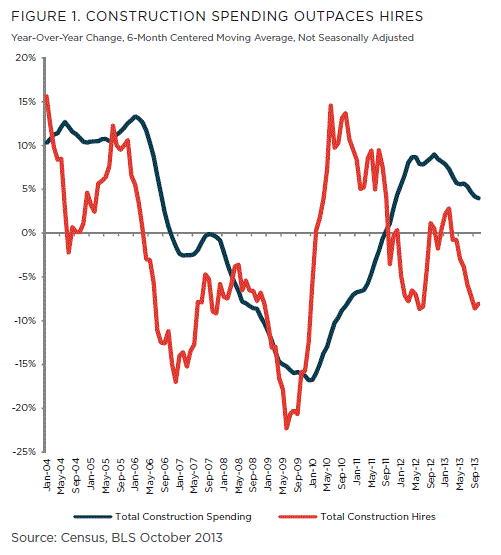
Thomas Vitlo, author of “Hesitation in the Construction Industry,” says that, while overall construction spending has increased since the end of the recession, construction employment has not kept pace.  He based his analysis on the Census Bureau’s “Value of Construction Put in Place Survey” and the Bureau of Labor Statistics “Job Openings and Labor Turnover Survey.  Vitlo used a six-month moving average to iron out the strong seasonality of activity in the construction industry.

In the resulting chart it is clear that, before the Great Recession, the two series were fairly well correlated.  Construction hiring fell as spending declined and rose as spending increased.  Then in early 2010 the two diverged.  Spending fell to a low of 16.8 percent in December 2009 and increased to a peak of 9 percent year-over-year in October 2012.  Total construction hires, however peaked at 14.6 percent in June 2010 and have been decreasing by 8 percent year-over-year as of October 2013.  “Therefore,” Vitlo says, “as spending has generally increased over the past few years, construction hires have declined, averaging only a 1 percent increase since June 2010.”


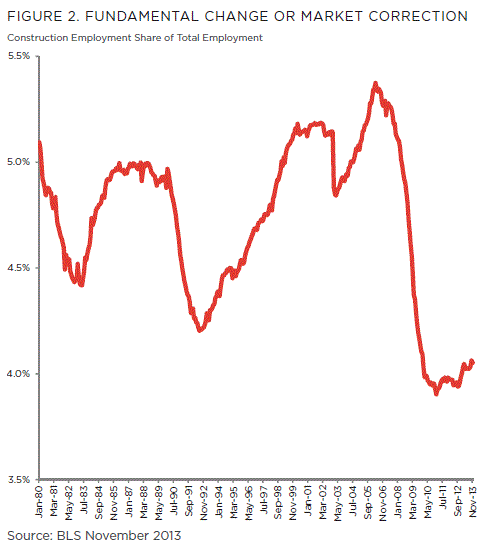
Coinciding with the shift in the relationship between hiring and spending is a reversal in construction employment.  The BLS employment figures show that in the eight years before the recession construction employment averaged 7.1 million but since September 2008 the average has been 5.8 million.   Even more intriguing, Vitlo says, is the share of employment going to construction.  Pre-recession construction employment averaged 5.1 percent share and it is now 4.1 percent.  After the peak-to-trough decline the share has plateaued for 50 months.


Wednesday, February 5, 2014

Study: U.S. Has Most of World’s Affordable Marketsm - Key West Real Estate Blogs

Contact Key West real real estate agents at our Key West real estate company for help with finding Key West homes for sale and we also offer Key West commercial real estate services
Study: U.S. Has Most of World’s Affordable Markets
The U.S. has the most major markets in the world where buying property is considered affordable, according to the Demographia International Housing Affordability Study, an analysis of 360 cities in nine countries.
Pittsburgh leads the pack in affordability among major cities around the globe. Other affordable major U.S. cities that topped the list were Detroit; Grand Rapids, Mich.; Rochester, N.Y.; Atlanta; Buffalo, N.Y.; Cincinnati; Cleveland; Indianapolis; and St. Louis.
Of the 360 worldwide markets evaluated in the study, 95 were labeled “affordable” (of which 84 were in the U.S.). On the other extreme, 67 metros in the study were labeled “seriously unaffordable markets” (23 in the U.S., led by San Francisco).
The study showed that those who pay the most in the world for housing are often getting the least as far as house size.
“The smallest houses are in the most expensive market (Hong Kong), while the largest houses are in the United States, which has the best major-market housing affordability. (Ireland has the best overall housing affordability),” according to the report.
Source: Demographia International Housing Affordability Study

Monday, February 3, 2014

Key West Real Estate Listings – Nearly Every U.S. City Can Expect a Good 2014

Visit our Key West real estate listings online to view current Key West real estate mls listings for Key West homes for sale


Nearly every city in the U.S. is expected to see economic growth in 2014, according to a new report by the U.S. Conference of Mayors. The city expected to lead the country in economic growth and job gains is Naples, Fla.

Other large cities expected to see big growth this year: Raleigh, N.C.; Atlanta; and Austin, Texas, according to the report, which was conducted by IHS Global Insight.

Cities that were hit hard by the decline in manufacturing or the housing crisis are also forecasted to see a big turnaround. For example, Youngstown, Ohio, and Buffalo, N.Y., are expected to see economic growth of 1.6 percent and 1.5 percent, respectively.

“The key thing in the northeast was the stabilization of housing,” says Jim Diffley, a senior director at IHS and lead author of the report. “When prices normalized and people weren’t underwater anymore, small but positive job growth has been able to stimulate spending.”

One of the biggest turnaround towns is expected to be Shreveport, La., which, the report shows, will grow by 1.6 percent after a 5.2 percent decrease last year.

Nearly Every U.S. City Can Expect a Good 2014


College towns, such as Austin, Charlottesville, Va., and Lawrence, Kan., are expected to be strong performers this year. However, large urban areas, such as New York, Chicago, and Los Angeles, are expected to grow more slowly than the national average. Diffley says that many large cities such as those have already recovered many of the local jobs that had been lost in the recession, and that’s why they likely will only experience slow growth this year.

Overall, IHS predicts that 340 of 363 metro areas will see their economies grow by at least 1 percent this year. That’s an increase from 183 metros last year. What’s more, 69 of those metros are expected to see growth of 3 percent or more. Only seven of the 363 metro areas will likely not see their economies grow this year, still an improvement over last year’s 97 metros that saw their economies stagnate.

“Two thirds of metros have still not gotten back to 2007 or 2008 peak levels of employment, and half of those won’t get there for another three years,” Diffley says. “Financial crises do not produce normal recessions in the U.S.”

Source: “U.S. mayors: Economy’s gains will spread widely,” USA Today

Friday, January 31, 2014

Freddie’s QC Goals; Jumbo Investor Chatter; Lender Updates; Where is Fannie & Freddie’s Business Coming From?

Freddie’s QC Goals; Jumbo Investor Chatter; Lender Updates; Where is Fannie & Freddie’s Business Coming From?


Post to this Key West real estate blog by Joe D Wells
Freddie’s QC Goals; Jumbo Investor Chatter; Lender Updates; Where is Fannie & Freddie’s Business Coming From?
“The check’s in the mail!” Hah! The Fed reports the number of checks paid has declined from close to $50B in the 1990s to about $20B. With tax rates being what they are, and many chafing at increased government intervention in most areas of our lives, perhaps we’re heading toward a barter economy.
I have heard of broadcasts, and podcasts, but…tipcasts? That’s a new one for me – but Freddie has one from Chris Mock, Freddie’s VP of QC, deals with Freddie’s quality control goals, and is worth two minutes of your time.
Yesterday the commentary mentioned the layoffs at Flagstar – it turns out that the number is 600 of our brethren who will be on the streets. “Flag” said it will create annualized cost savings of $40 million for the company. “In 2013 we made important progress in resolving certain legacy issues, and we are now focused on further strengthening our financial and operational foundation,” said Alessandro DiNello, Flagstar’s President and Chief Executive Officer.  “We are committed to being a highly efficient and best-in-class operator in each of our businesses, and this restructuring will align our infrastructure with today’s business environment, including the significantly reduced mortgage origination market.” But why is any lender different than Flagstar and looking at production versus overhead? We can expect to see continued cutbacks, and selective hiring.

“Rob, what do year from jumbo investors out there? We continue to be beat up on our pricing by the big bank’s retail channel.” I don’t see that changing much – they have huge amounts of deposits that need to be put to work. And we all know that those jumbo loans are often great credit risks – and there are no pesky gfees to worry about. The recent about-face on gfee changes is wreaking havoc with some of these new private equity investment funds. They are there to purchase jumbo production, and are probably not happy with the recent Mel Watts statement pushing gfee increased down the road. They are basically trying to figure out what they should be buying and were counting on continued gfee hikes – they cannot compete with the likes of Wells Fargo and other banks though seems they are looking to setup a few big accounts to purchase production from—i.e. large regional banks.
For example, let us look at 5/5 jumbo ARM loans – it is indicative of other products. It is a good product, but with limited investor interest. Everyone wants to get setup with Pentagon Federal’s correspondent program as they have a 5/5 ARM – but word on the street is that PenFed is not bringing on new clients. So are there 5/5 jumbo correspondent buyers, either delegated or non-delegated? Mark Paoletti with Mortgage Elements writes, “In the past the 5/5 used to be a popular product of Community Banks, S&L’s and Credit Unions. It was a good product to help the depository do Asset/Liability matching against 5 year CD’s. But that was when many depositors had a habit of rolling a 5 year CD into a new 5 year CD when it came due and the institution could count on new 5 year CD’s on a regular basis. Institutions also matched 5 year CD’s to 5 year auto loans and assigned limited funds to mortgage product restricting their availability. They may do them for their own retail but won’t offer them on a wholesale or correspondent basis. When their belly was full they pulled the product. That’s why those 5/5 ARMs always had a history of appearing then disappearing.”
What is also very telling is the percent of Freddie and Fannie volume coming from their “Top 5″ lenders. If you compare 2008 versus 2013, and include all lenders’ channels, the percentage of F&F’s total volume from the top five sellers has been declining since 2012. In the 4th quarter of 2013, the top five lenders comprised only 39% of Fannie’s total volume, compared to 61% in 2008. Freddie derived 43% from the top five versus 60% in 2008. As “Inside Mortgage Trends” points out, this is due to a number of factors, including some top lenders downsizing or bailing entirely, an increase in smaller lenders and smaller lenders selling directly to F&F (versus selling to the aggregators, who then in turn sell to the agencies), and the rise of large non-bank servicers like Nationstar, Walter, or Ocwen. And speaking of servicing – the same thing is happening there: it has become more spread out over a diverse group of companies.
This is by no means an endorsement of the program, or Chase Bank, but I found this interesting. Four years ago Chase launched its Mortgage Cash Back program; a program which allows customers with a new or refinanced mortgage – and a personal checking account – to earn up to $500 annually. Recently Chase announced that more than 368,000 customers received $87 million since the company launched the program, and that they will distribute $4 million in December ’13 alone to customers with loan anniversaries occurring in the month. In 2013, Chase will pay out $37 million in program incentives. For those not familiar with the program, mortgage payments are automatically deducted from a Chase personal checking account and on the anniversary of their loan each year, customers can cash out or pay down the principal on their mortgages to save even more. By choosing the pay down option, customers receive an additional savings in interest, which could lead to paying off their mortgage early.
Let’s continue on with company-specific news to see some other trends out there. As always, it is best to read the complete bulletin for full details!
SunTrust retired its high price exception for FHA transactions as of January 10th and is now requiring only one appraisal for Key Loans up to $1.5 million.
Per the Dodd-Frank rule on Points and Fees, First Community Mortgage is imposing a maximum compensation percentage of 2.75% for brokered transactions, and any loans locked within FCM limits which later fail to comply with the 3% threshold may be required to transition to borrower-paid or may have the lender administration fee lowered.  A new “No Lender Administration Fee” option will be available for all programs apart from Jumbo that will allow lenders to price the loan with the lender admin fee as a .625 LLPA that will be incorporated into the net price shown on the pricing engine for all lender-paid compensation scenarios.  This does not apply to VA loans, which will not be subject to an FCM Lender Administration Fee or any additional pricing adjustment for the no fee option.  The minimum compensation requirements have also been removed.
First Community Mortgage has announced that it will be expanding its lending territory into Iowa, North Dakota, and South Dakota, where it will offer all of its loan types subject to the specific product’s geographical restrictions.
The Agencies have issued a reminder that they will be implementing the second phase of the UAD compliance warning edits, which will be changed to fatal UAD edits in the UCDP on January 26th.  This affects the Quality of Construction Rating, Location Rating, View Rating, and Condition Rating data fields.  Any appraisal submitted to the UCDP that receives one or more fatal UAD edits will result in the issuance of Hard Stop 401 and the receipt of a “Not Successful” status, which makes it ineligible for delivery to either GSE.
Beginning February 17th, the Agencies will be requiring sellers to implement several new data elements into the ULDD, including the disclosed rate index (index rate used to draw closing docs for ARMs) and number of mortgaged properties (total number of mortgages properties for all borrowers on the loan, including the subject property).
Effective for all loans with applications dated January 14th and after, FNMA has revised its condo and PUD policies to allow no more than six month of regular common expensive assessments to have priority over the FNMA mortgage lien, even in cases where the law provides for a longer priority period.  Although the FNMA selling guide does not currently provide for this, the condo or PUD project legal documents must show compliance with this requirement.  This revision does not affect projects located in jurisdictions that enacted a law on or before January 14th that allows regular common expense assessments to have priority for more than six months, provided that the law references FNMA’s requirements (i.e. the Uniform Condominium Act or the Uniform Common Interest Ownership Act).
Wells Fargo has updated its Residual Income Evaluation to exclude FHA transactions, even when they are classified under rebuttable presumption.  FHA loans with RESPA application and case number assignment dates of January 10th or after are required to comply with QM, including Points and Fees, as are all such transactions where the RESPA application is dated before January 10th.  For transactions with case numbers assigned before this date, the loan should be underwritten to comply with HUD guidelines and will be reviewed by Wells under the temporary provisions by the CFPB.
Effective for RESPA applications dated on or after January 10th, HPML transactions will be ineligible for Wells Prior Approval; however, they may still be qualified using delegated underwriting authority.
In response to recent market activity, Wells is revising its Non-Agency ARM purchase pricing adjustor from 62.5bps to 37.5bps, effective for all Best Efforts transactions locked, re-locked, or re-negotiated on or after January 21st.  For all Non-Conforming locks, re-locks, and re-negotiations, the FICO adjustor for LTVs between 70.01 and 80% has been revised to -.125.
Chase has updated its Non-Agency debt analysis guidelines to exclude Federal, State, and local taxes; FICA or other retirement contributions; commuting costs; union dues; open revolving accounts with zero balances (with the exception of HELOCs); automatic deductions to savings accounts; child care; and voluntary deductions from being included in the DTI ratio.  The derogatory credit guidelines as they pertain to DU and LP have been revised to encompass both FNMA and FHLMC guidance on seasoning requirements.
Chase’s FHA guidance has been updated to prohibit the use of real estate tax credits as qualifying assets to offset the minimum 3.5% down payment requirement, and while a seller real estate tax credit can be applied towards the cash to close on the HUD-1, the down payment must be verified regardless of cash brought to or received at closing.
Turning to the markets: up a little, down a little. Yesterday rates were down a little, the 10-yr closed at 2.84%, and agency MBS prices were better by about .250 – mostly based on supply versus demand: the Fed is buying $2.86 billion a day and mortgage banker supply is only producing about $1.1 billion. (Also boosting Treasury performance Thursday was the latest monthly capital flows release from the Treasury department which highlighted that China and Japan boosted their holdings of Treasury bonds by $12 and $12.2 billion in November, respectively, to a record high.) There is certainly nothing for “inflation folks” to talk about – there is very little movement in the CPI or PPI. We will have a little news today, consisting of the December Housing Starts and Building Permits duo (they came out pretty close to expectations, but Housing Starts were down almost 10%, and Permits were down 3%), the December Industrial Production and Capacity Utilization couplet, and the normally forgettable preliminary January Consumer Sentiment number. From the housing numbers this morning, MBS prices have improved slightly and the 10-yr is down to 2.83%.


THESE ARE ACTUAL COMPLAINTS RECEIVED BY THOMAS COOK VACATIONS FROM DISSATISFIED CUSTOMERS (part 2 of 2):
11. “The roads were uneven and bumpy, so we could not read the local guide book during the bus ride to the resort. Because of this, we were unaware of many things that would have made our holiday more fun.”
12. “It took us nine hours to fly home from Jamaica to England. It took the Americans only three hours to get home. This seems unfair.”

13. “I compared the size of our one-bedroom suite to our friends’ three-bedroom and ours was significantly smaller.”
14. “The brochure stated: ‘No hairdressers at the resort’. We’re trainee hairdressers and we think they knew and made us wait longer for service.”
15. “There were too many Spanish people there. The receptionist spoke Spanish, the food was Spanish. No one told us that there would be so many foreigners.”

16. “We had to line up outside to catch the boat and there was no air-conditioning.”
17. “It is your duty as a tour operator to advise us of noisy or unruly guests before we travel.”
18. “I was bitten by a mosquito. The brochure did not mention mosquitoes.”
19. “My fiancé’ and I requested twin-beds when we booked, but instead we were placed in a room with a king bed. We now hold you responsible and want to be re-reimbursed for the fact that I became pregnant. This would not have happened if you had put us in the room that we booked.”


Wednesday, January 29, 2014

Study: U.S. Has Most of World’s Affordable Markets

Contact Key West real estate agents at our Key West real estate company for help with finding Key West homes for sale and we also offer Key West commercial real estate services
Study: U.S. Has Most of World’s Affordable Markets
The U.S. has the most major markets in the world where buying property is considered affordable, according to the Demographia International Housing Affordability Study, an analysis of 360 cities in nine countries.
Pittsburgh leads the pack in affordability among major cities around the globe. Other affordable major U.S. cities that topped the list were Detroit; Grand Rapids, Mich.; Rochester, N.Y.; Atlanta; Buffalo, N.Y.; Cincinnati; Cleveland; Indianapolis; and St. Louis.
Of the 360 worldwide markets evaluated in the study, 95 were labeled “affordable” (of which 84 were in the U.S.). On the other extreme, 67 metros in the study were labeled “seriously unaffordable markets” (23 in the U.S., led by San Francisco).
The study showed that those who pay the most in the world for housing are often getting the least as far as house size.
“The smallest houses are in the most expensive market (Hong Kong), while the largest houses are in the United States, which has the best major-market housing affordability. (Ireland has the best overall housing affordability),” according to the report.
Source: Demographia International Housing Affordability Study

Monday, January 27, 2014

Florida Battles Highest Foreclosure Rates – key west homes for sale

Joe D Wells Key West real estate blogs for real estate news. Please contact us for more information about Key West homes for sale

Florida Battles Highest Foreclosure Rates – key west homes for sale


While foreclosures have fallen by 26 percent nationwide in the past year, Florida continues to be a hotbed for foreclosures, according to recent data from RealtyTrac. Among the top 10 cities with the highest foreclosure rates in the country, eight are in Florida.
Long delays in processing the foreclosures have been part of the state’s problem. It ranks No. 3 among states with the longest timelines for completed foreclosures, taking an average of 944 days in the state. (In New York, it takes an average of 1,029 days, and in New Jersey, it takes 999 days.)
“Millions of home owners are still living in the shadow of the massive foreclosure crisis that the country experienced over the past eight years since the housing bubble burst — both in the form of homes lost directly to foreclosure as well as home equity lost as a result of a flood of discounted distressed sales,” says Daren Blomquist, vice president at RealtyTrac.  “But the shadow cast by the foreclosure crisis is shrinking as fewer distressed properties enter foreclosure and properties already in foreclosure are poised to exit in greater numbers in 2014, given the greater numbers of scheduled foreclosure auctions in 2013 in judicial states — which account for the bulk of U.S. foreclosure inventory.”
Florida’s scheduled judicial foreclosure auctions are up 53 percent in the past year. Scheduled judicial foreclosure auctions are also up in other states facing high foreclosures, such as Maryland, New Jersey, Connecticut, Pennsylvania, and New York.
According to RealtyTrac, the following 10 metro areas posted the highest foreclosure rates in the U.S. in 2013:
  1. Miami: 3.93 percent of housing units received a foreclosure filing in December
  2. Jacksonville, Fla.: 3.32 percent
  3. Orlando: 3.20%
  4. Palm Bay-Melbourne-Titusville, Fla.: 3.16%
  5. Port St. Lucie, Fla.: 3.06%
  6. Tampa, Fla.: 3.06%
  7. Ocala, Fla.: 2.96%
  8. Rockford, Ill.: 2.59%
  9. Las Vegas: 2.45%
  10. Sarasota, Fla.: 2.42%
—By Melissa Dittman Tracey, REALTOR® Magazine

Friday, January 24, 2014

Home Remodeling Expected to Post Strong Year - Key West Real Estate

Home Remodeling Expected to Post Strong Year


Daily Real Estate News

Home remodeling is projected to continue the strong growth it started in the second quarter of 2013 into the first half of 2014, according to LIRA, the Leading Indicator of Remodeling Activity, at Harvard University’s Joint Center for Housing Studies.

Double-digit gains in spending are expected through the first half of this year with remodeling. In the third quarter, however, growth is expected to level off to just under 10 percent, LIRA projects.

“The ongoing growth that we’ve seen in home prices, housing starts, and existing home sales is also being reflected in home improvement activity,” says Eric S. Belsky, managing director of the Joint Center.  “As owners gain more confidence in the housing market, they are likely to undertake home improvements that they have deferred.”

Still, the strong growth in the remodeling market may start to recede around mid-year, says Kermit Baker, director of the Remodeling Futures Program at the Joint Center.  “By that time, we’ll be approaching the pre-recessionary levels of spending, and with borrowing costs starting to creep back up, growth rates are likely to slow some,” Baker notes.

Source: “Home Remodeling Will be Strong into 2014,” Mortgage News Daily

Monday, January 6, 2014

Mortgage Rates Edge Higher Entering 2014 - Key West Real Estate

Mortgage Rates Edge Higher Entering 2014

Daily Real Estate News | Friday, January 03, 2014
Fixed mortgage rates continued an upward climb this week, with the 30-year fixed-rate mortgage starting the year more than a full percentage point higher than last year at this time, Freddie Mac reports in its weekly mortgage survey.
“Mortgage rates edged up to begin the year on signs of a stronger economic recovery,” says Frank Nothaft, Freddie Mac’s chief economist.
Freddie Mac reports the following national averages for mortgage rates for the week ending Jan. 2:
  • 30-year fixed-rate mortgages: averaged 4.53 percent, with an average 0.8 point, up from last week’s 4.48 percent average. Last year at this time, 30-year rates averaged 3.34 percent.
  • 15-year fixed-rate mortgages: averaged 3.55 percent, with an average 0.7 point, rising from last week’s 3.52 percent average. A year ago, 15-year rates averaged 2.64 percent.
  • 5-year hybrid adjustable rate mortgages: averaged 3.05 percent, with an average 0.4 point, rising from last week’s 3 percent average. Last year at this time, 5-year ARMs averaged 2.71 percent.
  • 1-year ARMs: averaged 2.56 percent, with an average 0.5 point, holding the same average as last week. A year ago, 1-year ARMs averaged 2.57 percent.
Source: Freddie Mac

Homes for sale Key West Florida

5 Top Searched ZIP Codes in 2013 - Key West Homes for Sale

5 Top Searched ZIP Codes in 2013

Daily Real Estate News | Friday, December 20, 2013
What are the most searched neighborhoods in the country? Realtor.com® analyzed its ZIP code search data to determine the most-searched neighborhoods and hottest places to live in 2013.
Noted for their great sense of community, small-town feel, charming homes, among other features, here are the cities that topped realtor.com®’s list:
1. Old Town: Chicago – 60610
2. McKinney, Texas - 75070
3. Wellington: West Palm Beach, Fla. – 33414
4. Pembroke Pines: Hollywood, Fla. – 33028
5. Ballantyne: Charlotte, N.C. - 28277
Read more about what makes the top-searched neighborhoods unique at realtor.com®. 
Source: “The Year’s Most Searched ZIP Codes,” realtor.com (Dec. 16, 2013)

Key West homes for sale

Friday, January 3, 2014

Pending Home Sales Edge Up in November

WASHINGTON (December 30, 2013) – Pending home sales stabilized in November with a slight gain, according to the National Association of Realtors®. Monthly increases in the South and West offset declines in the Northeast and Midwest.
The Pending Home Sales Index,* a forward-looking indicator based on contract signings, inched up 0.2 percent to 101.7 in November from a downwardly revised 101.5 in October, but is 1.6 percent below November 2012 when it was 103.3. The data reflect contracts but not closings.
Lawrence Yun, NAR chief economist, said the market is flattening. “We may have reached a cyclical low because the positive fundamentals of job creation and household formation are likely to foster a fairly stable level of contract activity in 2014,” he said. “Although the final months of 2013 are finishing on a soft note, the year as a whole will end with the best sales total in seven years.”
Yun said the market still favors buyers in most of the country, but higher mortgage interest rates in combination with strong price gains mean a more modest growth in values is expected in 2014.
The PHSI in the Northeast declined 2.7 percent to 82.6 in November, but is 1.9 percent above a year ago. In the Midwest the index fell 3.1 percent to 100.6 in November, but is 0.4 percent higher than November 2012. Pending home sales in the South rose 2.3 percent to an index of 116.1 in November, and are 0.1 percent above a year ago. The index in the West increased 1.8 percent in November to 95.0, but is 8.7 percent below November 2012, in part from inventory constraints.
Total existing-home sales this year are expected to reach 5.1 million, a gain of almost 10 percent over 2012, but should stay at that level in 2014, and then rise to 5.3 million in 2015. The national median existing-home price for all of this year will be close to $197,300, up nearly 12 percent from 2012, but is projected to rise at a more moderate pace of 5 to 5.5 percent in 2014, and grow another 4 percent in 2015.
The National Association of Realtors®, “The Voice for Real Estate,” is America’s largest trade association, representing 1 million members involved in all aspects of the residential and commercial real estate industries. For additional commentary and consumer information, visit www.houselogic.com and http://retradio.com.
# # #
*The Pending Home Sales Index is a leading indicator for the housing sector, based on pending sales of existing homes. A sale is listed as pending when the contract has been signed but the transaction has not closed, though the sale usually is finalized within one or two months of signing.
The index is based on a large national sample, typically representing about 20 percent of transactions for existing-home sales. In developing the model for the index, it was demonstrated that the level of monthly sales-contract activity parallels the level of closed existing-home sales in the following two months.
An index of 100 is equal to the average level of contract activity during 2001, which was the first year to be examined. By coincidence, the volume of existing-home sales in 2001 fell within the range of 5.0 to 5.5 million, which is considered normal for the current U.S. population.
NOTE:  Existing-home sales for December will be reported January 23 and the next Pending Home Sales Index will be January 30; release times are 10:00 a.m. EST.

OceanBlueRealEstate.com

Could Interest Rates Get Buyers Off the Fence?

Though borrowing costs are increasing as interest rates have lifted from their historical lows, some real estate professionals believe the rise may boost home sales.
“It will get people sitting on the fence to decide, ‘We better do something or it’s going to cost us money,’” says Margaret Dixon, a real estate sales associate with Crye-Leike in Tennessee.
At the end of 2012, 30-year fixed-rate mortgages averaged 3.52 percent. Last week, Freddie Mac reported that 30-year rates averaged 4.47 percent.
“A 1 percent increase usually lands around $30,000 in buying power,” says Todd Reynolds, a real estate professional with Goodall Homes. “That’s the difference between a starter home and a bigger home — or a bonus room.”
Higher interest rates, along with higher home prices, may prompt more home buyers to act quickly before costs rise any more.
“They realize the house of their dreams may never be cheaper than it is today,” says Reynolds. “It creates a sense of urgency.”
Economists are predicting that mortgage rates will likely rise to 5 percent or 5.5 percent in 2014.
“Most people realize the [3 percent-range interest rates] are gone, and they’d better be glad to get 4.5 percent,” Jay Bradshaw, an agent in Cumberland, Tenn., told The Tennessean.
Source: “Rising interest rates may boost real estate market,” The Tennessean (Dec. 24, 2013)

OceanBlueRealEstate.com

Strong Demand Helps Buck Winter Trend

November’s median list prices nationwide remained “unusually strong for the season,” posting a 6.9 percent year-over-year increase, according to realtor.com’s National Housing Trend Report. Inventory of for-sale homes also stabilized in many markets after large drops at the beginning of the year, and homes were selling faster this November compared to last year.
“With demand in a much stronger position compared to last year, we anticipate these gains to remain steady into 2014, but with increases expected at a more moderate pace than we have seen in 2013,” says Errol Samuelson, president of realtor.com.
Of the 146 markets that realtor.com tracks, 111 posted year-over-year median list price increases of 1 percent or more.
The following markets led the nation with the largest year-over-year list price increases:
  1. Stockton-Lodi, Calif.: +47.06% (median list price: $250,000)
  2. Detroit: +39.04% (median list price: $125,000)
  3. Las Vegas, Nev.-Ariz.: +29.65% (median list price: $174,900)
  4. Santa Barbara-Santa Maria-Lompoc, Calif.: +28.28% (median list price: $799,000)
  5. Los Angeles-Long Beach, Calif.: +28.17% (median list price: $455,000)
  6. Orange County, Calif.: +27.45% (median list price: $599,000)
  7. Reno, Nev.: +26.89% (median list price: $260,000)
  8. Riverside-San Bernardino, Calif.: +26.67% (median list price: $285,000)
  9. Oakland, Calif.: +23.35% (median list price: $467,500)
  10. Fresno, Calif.: +22.99% (median list price: $230,000)
Source: realtor.com

OceanBlueRealEstate.com

Florida Keys Real Estate Search

Search This Blog